APWH Unit 8.2
Unit 8.2 — The Cold War(c. 1945–1991)
Essential Question:
What were the causes and effects of the ideological struggle of the Cold War?
One-glance Review
- United States and Soviet Union → Became rival superpowers after World War II
- Cold War → An ideological struggle between Capitalism and Communism
- United Nations → Created to preserve peace, but could not stop superpower tensions
- Containment → U.S. policy to stop the spread of Communism
- Truman Doctrine and Marshall Plan → Used aid and support to resist Soviet influence
- COMECON → Soviet response to Western economic rebuilding
- Sputnik and MAD (Mutual Assured Destruction) → Showed technological and military rivalry
- Non-Aligned Movement → Newly independent states tried to avoid choosing sides
Core Ideas
Ideological Rivalry after World War II
-
After World War II, the United States and the Soviet Union emerged as the two most powerful states in the world.
-
Their rivalry centered on:
- Economics
- Politics
- Military power
- Global influence
-
This struggle became known as the Cold War, a long-term conflict without direct full-scale war between the two superpowers.
The Cold War was a global struggle between rival ideologies, political systems, and spheres of influence.
KEY TERMS BY THEME
GOVERNMENT: Global Politics
- United Nations
- Iron Curtain
- Satellite Countries
- World Revolution
- Containment
- Truman Doctrine
- Non-Aligned Movement
TECHNOLOGY: Space and Military
ECONOMICS: International
LEADERS / THINKERS
- Harry Truman
- Joseph Stalin
- Winston Churchill
- George Kennan
- Jawaharlal Nehru
- Kwame Nkrumah
- Gamal Abdel Nasser
- Sukarno
1. Origins of the Cold War
Two Superpowers after World War II
- After World War II, the United States and the Soviet Union became the strongest countries in the world.
- Both expanded their influence after the war.
- After the Potsdam Conference in 1945, tensions between Truman and Stalin deepened.
Ideological Conflict
The central conflict of the Cold War was the rivalry between:
- Capitalism led by the United States
- Communism led by the Soviet Union
Why It Was “Cold”
-
The two sides competed for dominance(主导地位) in Europe, Asia, and the wider world
-
They avoided direct total war against each other
-
Instead, they relied on:
- propaganda(宣传)
- economic aid
- alliances
- arms competition
- proxy struggles(代理冲突)
The Cold War was “cold” because the two superpowers rarely fought each other directly, but they competed constantly in politics, economics, and military power.
2. Cooperation Despite Conflict: The United Nations
Why the UN Was Created
-
Even with growing tensions, the wartime Allies still supported creating a new international organization
-
The goal was to promote:
- peace
- security
- prosperity(繁荣)
Why the League of Nations Had Failed
The earlier League of Nations failed because:
- it lacked support from all major powers, especially the United States
- it lacked effective mechanisms(有效机制) to stop small conflicts from becoming large wars
Creation of the United Nations
- In 1943, leaders from the United States, Great Britain, the Soviet Union, and China discussed a new organization
- The United Nations was officially established in 1945
The United Nations reflected continued hopes for international cooperation, even as Cold War rivalry was beginning.
3. Rivalry in Economics and Politics
Capitalism and Communism
One major difference between the United States and the Soviet Union was their economic system.
In Capitalist Countries
- farms and factories were mostly privately owned
- economic decisions were shaped by private interests
- people were expected to act in their self-interest(自身利益)
In Communist Countries
-
economic assets were owned by the government
-
the system stressed:
- equality
- fairness
Democracy and Authoritarianism(专制主义)
Another major difference was political organization.
In the United States
- people chose leaders through free elections
- an independent press reported on politics
- political parties competed for votes
In the Soviet Union
- elections were not truly meaningful
- the press was controlled by the government
- one party dominated politics
Criticisms and Similarities
Each side attacked the other’s weaknesses.
U.S. criticisms of the USSR
- restrictions on free speech
- restrictions on freedom of worship(宗教崇拜自由)
- lack of free elections
- inefficient business operations
Soviet criticisms of the U.S.
- the poor had the “freedom to starve”
- racial discrimination against African Americans and other minorities
- weaker commitment to women’s equality
Important Complexity
- Despite their differences, both systems concentrated major decision-making power in large institutions
- Both societies also acted partly out of fear of the other
- This made the military highly influential in both countries
The Cold War was not only a military struggle. It was also a contest over which economic and political system would shape the modern world.
4. Conflict in International Affairs
Soviet Control in Eastern Europe
The Soviet Union tried to reshape Eastern Europe in its own image.
Countries such as:
- Bulgaria
- East Germany
- Hungary
- Poland
- Romania
were directed to adopt:
- five-year plans
- industrial development
- collective agriculture(集体农业)
- one-party rule
Satellite Countries
-
These states became Satellite Countries, meaning smaller countries politically or economically dependent on a more powerful state
-
They were forced to:
- import Soviet goods
- export mainly to the Soviet Union
-
Their governments were also highly dictatorial(独裁的)
World Revolution
-
Since the October Revolution of 1917, the Soviets had seen Capitalism as a threat
-
They also believed in World Revolution
- the idea that workers would overthrow capitalism everywhere
-
The Soviet Union supported uprisings in places such as:
- Germany
- Bavaria
- Hungary
- northern Italy
- Bulgaria
Effect on the West
- Soviet interference increased Western suspicion(怀疑) and fear
- After World War II, revolutionary movements seemed especially threatening in Central and Southern Europe
Soviet expansion in Eastern Europe convinced many Western leaders that Communism had to be resisted and contained.
5. Containment and the U.S. Response
Containment
-
U.S. diplomat (外交官) George Kennan argued that the Soviet Union would keep expanding if it could
-
He proposed the policy of Containment
- stopping Communism from spreading farther
Debate over Strategy
Some Americans thought Containment was too passive(过于被动).
- They preferred a more aggressive rollback(反推政策) strategy
- Rollback meant trying to overthrow existing Communist governments
Truman Doctrine (杜鲁门主义)
- In 1947, President Harry Truman announced the Truman Doctrine
- It stated that the United States would support countries resisting Communist domination
Important examples:
-
Turkey
- the Soviet Union wanted military bases there to control the Dardanelles
-
Greece
- left-wing groups influenced by Communists were close to taking control
-
Truman promised economic and military aid to both countries
Containment became one of the most important foundations of U.S. Cold War policy.
6. The Marshall Plan and COMECON
Marshall Plan
- After World War II, the United States wanted to rebuild Europe
- American leaders believed economic instability(经济不稳定) could lead to Communist revolutions
- In June 1947, the Marshall Plan offered $12 billion in aid to European nations, including Germany
The money was used to:
- modernize industry
- reduce trade barriers(贸易壁垒)
- rebuild infrastructure(基础设施)
Results of the Marshall Plan
- The plan was highly successful
- By 1951, economic output in aided countries was 35 percent higher than it had been in 1938
Soviet Response: Council for Mutual Economic Assistance
- The Soviet Union and its Eastern European allies rejected the Marshall Plan
- In 1949, the Soviets created the Council for Mutual Economic Assistance, or COMECON
COMECON
-
Focused mainly on:
- trade agreements
- credit arrangements(信贷安排)
-
Its impact was much more limited than that of the Marshall Plan
The Marshall Plan strengthened Western Europe economically, while COMECON tied Eastern Europe more closely to the Soviet bloc(集团).
7. The Space Race and the Arms Race
Sputnik and the Space Race
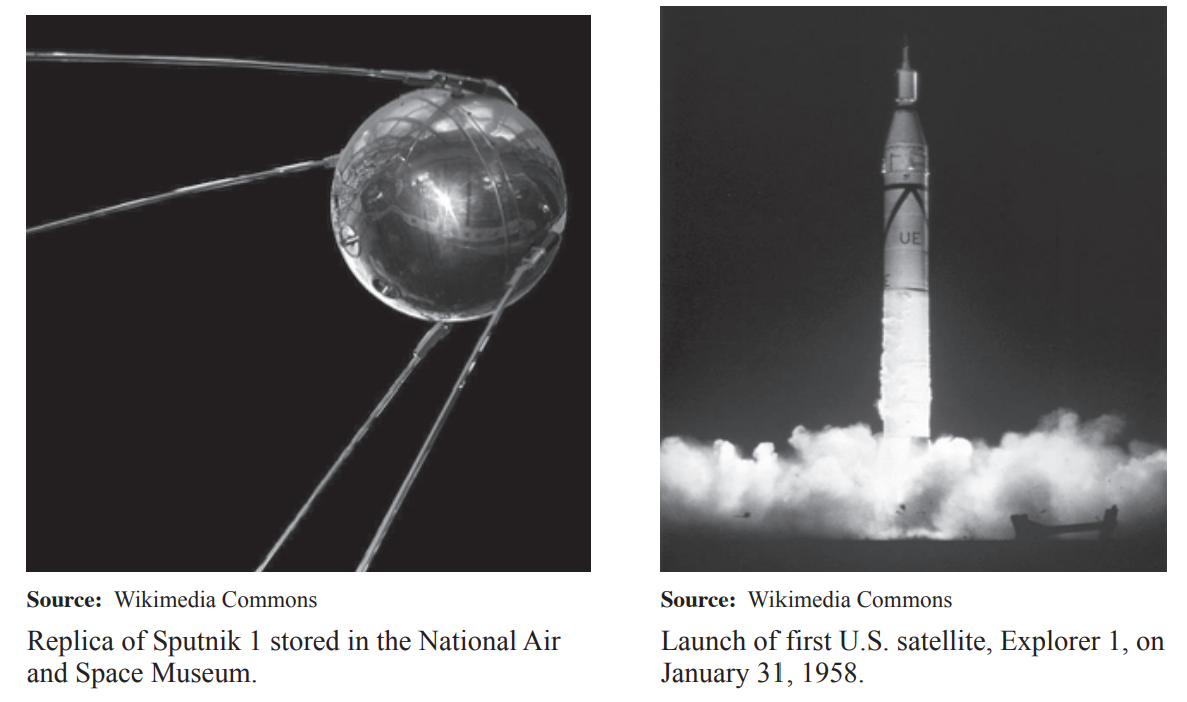
- In 1957, the Soviet Union launched Sputnik, the first artificial satellite(人造卫星), into orbit
- This event began the Space Race
- The United States launched its first satellite in January 1958
The two superpowers competed to become:
- first to orbit a human around Earth
- first to land a human on the moon
Mutual Assured Destruction
- In 1959, the Soviets tested the first ICBM (Intercontinental Ballistic Missile, 洲际弹道导弹) capable of delivering a nuclear warhead (核弹头) to U.S. territory
- The United States tested a similar missile (导弹) later that year
This led to Mutual Assured Destruction, or MAD:
- both sides had enough nuclear power to destroy each other completely
- neither side could win a nuclear war
- fear of total destruction discouraged direct war
Mutual Assured Destruction created a “balance of terror(恐怖平衡)” in which peace depended on the fear of annihilation(彻底毁灭).
8. The Non-Aligned Movement
Why It Emerged
- Many new countries in Asia and Africa did not want to join either the U.S. bloc or the Soviet bloc
- They wanted an international order not controlled by the two superpowers
Bandung Conference
- In 1955, Indonesia hosted the Bandung Conference
- Delegates from China, India, and 27 other countries attended
- Together they represented more than half of the world’s population
- They passed resolutions condemning (谴责) colonialism
Formal Creation
- The spirit of Bandung helped lead to the formal creation of the Non-Aligned Movement in 1961
Challenges of Non-Alignment
Non-aligned states faced serious difficulties:
- they wanted stronger international institutions while still protecting their own interests
- some states drifted closer to one superpower or the other
Example:
-
During the Somalia–Ethiopia war in 1977
- the Soviet Union aided Ethiopia
- the United States aided Somalia
Non-Aligned Movement members tried to remain independent, but Cold War pressures often made true neutrality difficult.
9. Leaders of the Non-Aligned Movement
Jawaharlal Nehru — India
- prime minister of India from 1947 to 1964
- one of the most important leaders at Bandung
- supported a stronger UN, though he resisted outside intervention in Kashmir
Kwame Nkrumah — Ghana
- led Ghana to independence from Great Britain in 1957
- supported African unity through the Organization of African Unity
- became one of the most respected postwar African leaders
Gamal Abdel Nasser — Egypt
- served as president of Egypt from 1954 to 1970
- helped negotiate compromises at Bandung
- supported Pan-Arabism (泛阿拉伯主义)
Sukarno — Indonesia
- first president of Indonesia
- organized and hosted the Bandung Conference
- criticized both superpowers but accepted aid from both
These leaders showed that Cold War history was not only about the United States and the Soviet Union. Newly independent states also shaped global politics.
10. Cause and Effect
Causes of the Cold War
- power vacuum(权力真空) after World War II
- ideological conflict between Capitalism and Communism
- Soviet expansion into Eastern Europe
- mutual suspicion (相互猜疑) between the United States and the Soviet Union
- competition for global influence
Effects of the Cold War
- division of Europe by the Iron Curtain
- creation of rival economic and political blocs
- spread of Containment policy
- economic reconstruction through the Marshall Plan
- military and technological competition through the arms race and Space Race
- rise of the Non-Aligned Movement among newly independent states
Continuity
- both superpowers continued to seek global influence
- fear and distrust remained central features of international politics
- smaller countries were often pressured to align with one side
Exam-ready Phrases and Sentences
-
Expand ideological influence
-
Divide Europe along political lines
-
Contain the spread of Communism
-
Rebuild war-torn economies(重建饱受战争摧残的经济)
-
Strengthen alliance systems
-
Compete for technological superiority(技术优势)
-
Escalate (升级) the arms race
-
Maintain a balance of terror
-
Reject superpower domination
-
Pursue (追求) non-alignment
-
The Cold War emerged from growing tensions between the United States and the Soviet Union after World War II.
-
The ideological conflict between Capitalism and Communism shaped global politics for decades.
-
The Truman Doctrine and Marshall Plan reflected the U.S. policy of Containment.
-
The Soviet Union consolidated control over Eastern Europe through Satellite Countries and centralized planning.
-
The launch of Sputnik intensified the Space Race between the superpowers.
-
Mutual Assured Destruction discouraged direct nuclear war while increasing global fear.
-
The Non-Aligned Movement represented efforts by Asian and African nations to avoid superpower control.
LEQ / DBQ 使用思路
可用论点(Thesis Ideas)
- After World War II, the rivalry between the United States and the Soviet Union created a global ideological struggle that divided the world politically, economically, and militarily.
- The Cold War was caused by conflicting visions of government and economics, and it led to containment policies, arms competition, and the emergence of non-aligned states.
- While the United States and the Soviet Union dominated Cold War politics, newly independent nations also shaped world affairs by resisting alignment with either superpower.
- The Cold War reshaped global relations by dividing Europe, intensifying military competition, and encouraging alternative movements such as the Non-Aligned Movement.