Labor Market
What is Demand for Labor?
Demand is the different quantities of workers that businesses are willing and able to hire at different wages. There is an inverse relationship between wage and quantity.
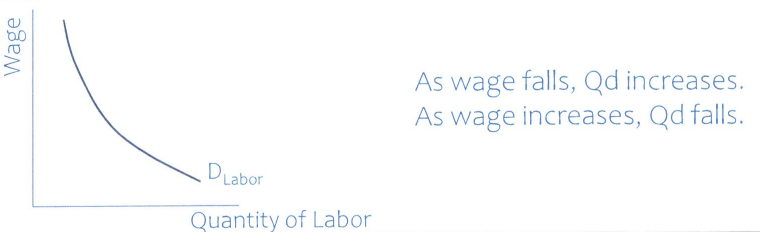
Firms demand labor.
Demand for labor shows the quantities of workers that firms will hire at different wage rates.
What shifts the demand for labor?
- Price of the output
If the price of the product goes up, the worker that produces the product becomes more valuable. - Productivity of the worker
A more productive worker is more valuable to a business. - Change in the price of other resources
Such as Substitute Resources, and Complementary Resources.
What is Supply for Labor?
Supply is the different quantities of individuals that are willing and able to sell their labor at different wages. There is a direct (or positive) relationship between wage and quantity of labor supplied.
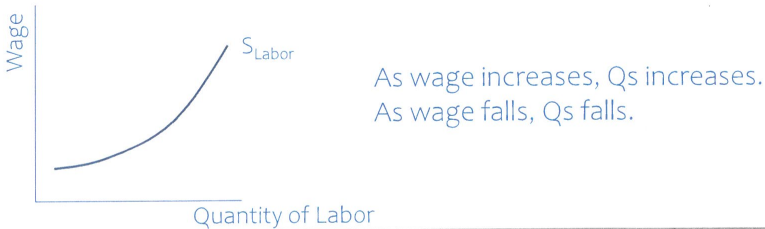
Individuals supply labor.
As wage falls, Qd increases. As wage increases, Qd falls. Supply of labor is the number of workers that are willing to work at different wage rates. Higher wages give workers incentives to leave other industries or give up leisure activities.
What shifts the supply of labor?
- Education and training
- Availability of alternative options
- Immigration and mobility of workers
- Cultural expectations
- Working conditions
- Preferences for leisure
Equilibrium in the Labor Market
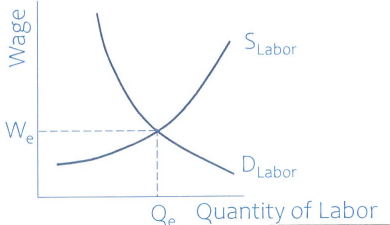
Wage (the price of labor) is set by the market.
Marginal Revenue Product (MRP) = Marginal Resource Cost (MRC)
相关笔记
Perfectly Competitive Labor Market
Labor Market Imperfections