Monopoly
Characteristics of Monopoly
- One large firm (the firm is the market)
- Unique product (no close substitutes)
- High Barriers - firms cannot enter the industry
- Monopolies are Price Makers
- Some advertising
Tip
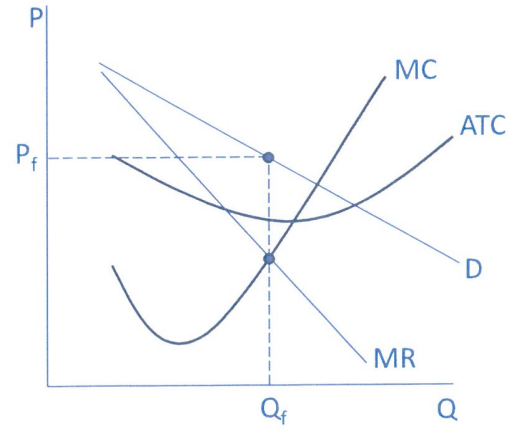
MR=MC rule still applies.
Some monopoly is called Natural Monopoly, as they are the single firm and produced at Economies of Scale.
Here's the explanation in English:
Allocative Efficiency
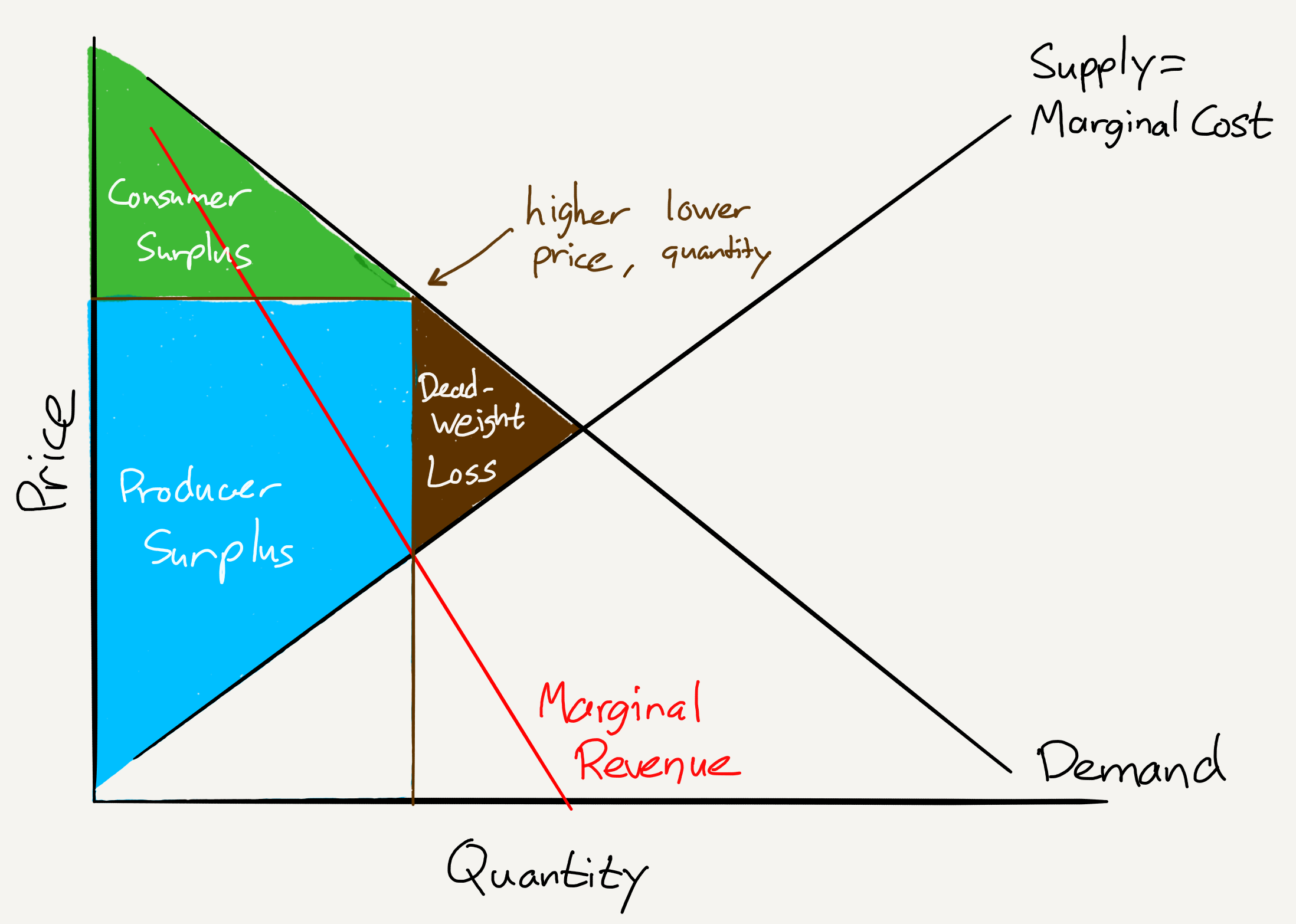
- Condition: Price equals Marginal Cost (( P = MC )). This ensures that the last unit produced is valued by consumers exactly at the cost of resources used to make it.
- Monopoly Outcome: A monopolist maximizes profit where Marginal Revenue equals Marginal Cost (( MR = MC )). Because the demand curve is downward sloping, ( MR < P ). Therefore, at the monopoly output, ( P > MC ).
- Result: The monopoly produces less than the allocatively efficient quantity, creating a Deadweight Loss (DWL).
Productive Efficiency
- Condition: Producing at the lowest point on the Average Total Cost curve (( ATC_{min} )).
- Monopoly Outcome: There is no inherent mechanism forcing a monopoly to produce at minimum ATC. Unlike perfect competition, where long-run equilibrium forces firms to the efficient scale, a monopolist may operate with Excess Capacity or at a higher cost.
- Result: Monopolies are not necessarily productively efficient; they can sustain higher average costs due to lack of competitive pressure.
Summary Comparison
| Efficiency Type | Condition | Monopoly Performance |
|---|---|---|
| Allocative | ( P = MC ) | Inefficient (( P > MC )) |
| Productive | ( \text{Min } ATC ) | Not Guaranteed (X-inefficiency possible) |
相关笔记
Natural Monopoly
Imperfect Competition
Comparison Table of The 5 Market Structure